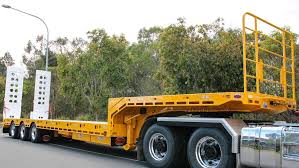
Drop Deck Trailers
There are several main types of trailers that are specialised to help shippers to transport abnormally heavy, wide or tall cargo that would otherwise not fit in a closed truck. There are more than fifteen types of trailers designed for this purpose, but three are famous for this purpose. These are:
- Flatbed trailers. These are the basic forms of trailers. They are flat and do not have sides or roof thus providing quick and easy access during loading and unloading. Since there is no cover for protection of the goods in transit, it is therefore ideal for non-perishable goods or goods that may be affected by precipitation. Such freight includes machinery, tubing, steel products, and construction equipment.
- Drop deck or step deck trailers. They have two deck levels, that is, the upper deck and the lower deck. The lower deck drops from the end of the tractor unit. Drop decks are the ideal option for hauling loads are that are taller than usual. There are various lengths of step deck trailers which can be pulled by sleeper or day cab trucks. Drop deck trailers are built to withstand high load capacities and ensure the safety of cargo during loading and offloading because they are not as high as their flatbed counterparts. Some drop deck trailers also have loading and unloading ramps. They are ideal for cargo such as tractors, machinery and any other massive cargo that is more than feet tall.
- Double drop deck trailers. They are usually longer with a dipped level in the middle of two high levels to create a ‘well’. The well can measure approximately 25 to 29 feet. This space is suitable for short oversized cargo that is more than 10 feet tall. Some examples include forklifts, cars, trucks, construction equipment, and tanks.
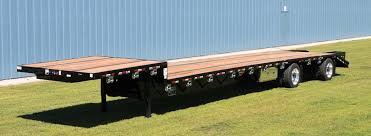
Using drop deck trailers
What are drop deck trailers? Here are its main functions and purposes.
- When the cargo has abnormal height proportions. Drop deck trailers are specifically designed to be loaded with taller cargo that would otherwise be above the legal parameters if they were to be shipped on flatbeds. The drop on the lower level creates approximately three more feet of space.
- When the safety of the cargo is a priority. Drop deck trailers are safer to load and unload with a forklift pickup than flatbed trailers. Drop deck trailers are nearer to the ground, thus ensuring quicker and safer unloading. Also, some drop deck trailers have unloading ramps which are ideal for unloading vehicles, tanks and other machinery.
- When the goods are large and heavy and need to be loaded with a crane. Drop deck trailers are generally more stable than flatbeds. The trailer can handle the weight of the cargo with ease because of the decreased centre of gravity that is a result of the small rear tyres.
- When you need a customised trailer to transport your freight. Some goods are most suited to be shipped by a drop deck trailer to ensure the logistics cost are at a minimum. For instance, a drop deck trailer with ramps would be the best option for transporting cars, tanks and other machinery with wheels. This will likely cut down on the offloading costs that incurred if such cargo is transported with a flatbed trailer.
In conclusion, the height measurements of your cargo as well as the ease and logistics of loading and offloading favours the use of drop deck trailers for shipping heavy and abnormally tall freight.